Antimicrobial resistance (AMR) is one of the top global public health challenges of the current times
which threatens the reversal of gains of modern medicine. Appropriate containment measures are required
to be undertaken on an urgent basis to prevent untreatable illness from becoming a reality.
Government of India has given due cognizance to the problem of AMR and launched the “National
Programme on AMR Containment” during the 12th five-year plan in the year 2013. The programme is
being coordinated by the Centre for Bacterial Diseases and Drug Resistance (CBDDR), National Center
for Disease Control (NCDC).
1. AMR Surveillance
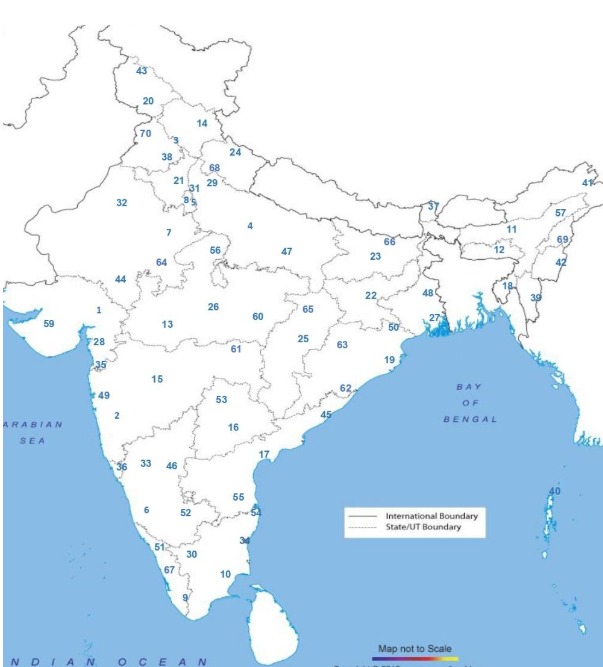
Under the programme, for the accomplishment of first objective, National AMR
Surveillance network (NARS-Net) has been established in 2013 to determine the magnitude and
trends of AMR in different geographical regions of the country. The labs under NARS-Net include
government medical colleges. The number of labs in the network have been expanded in a phased
manner and are required to submit AMR surveillance data of nine priority bacterial pathogens of
public health importance, viz., Staphylococcus aureus, Enterococcus species, Klebsiella species,
Escherichia coli, Pseudomonas aeruginosa, Acinetobacter baumannii/ Acinetobacter calcoaceticus
complex, Salmonella enterica serotypes Typhi and Paratyphi, Shigella species and Vibrio cholerae.
Among the fungal pathogens, Candida spp, from bloodstream infections are also to be submitted to
the NRL for AMR in fungal pathogens for confirmation and AFST.
Under the programme, sites are supported for maintaining essential infrastructure, reagents and consumables, manpower support for ensuring Internal quality testing and generation of quality AMR data and entry into the designated software. NCDC provides technical support to network laboratories to ensure generation of quality AMR data. Sites perform AST by disk diffusion, broth microdilution, agar dilution, and automated antimicrobial susceptibility testing systems as per the programme SOPs developed at NCDC.
Both NRLs also carry out trainings for building capacity of NARS-Net sites.
1. BJ Medical College, Ahmedabad, Gujarat
2. BJ Medical College, Pune, Maharashtra
3. Government Medical College, Chandigarh
4. GSVM Medical College, Kanpur, Uttar Pradesh
5. Lady Hardinge Medical College and Associated hospitals, Delhi
6. Mysore Medical college, Mysuru, Karnataka
7. SMS medical College, Jaipur, Rajasthan
8. Vardhman Mahavir Medical college and SJ Hospital, Delhi
9. Govt. Medical College, Thiruvananthapuram, Kerala
10. KAP V. Government Medical College, Tiruchirappalli, Tamil Nadu
11. Gauhati Medical College and Hospital, Guwahati, Assam
12. NEIGRIHMS, Shillong, Meghalaya
13. MGM College and Hospital, Indore, Madhya Pradesh
14. IGMC, Shimla, Himachal Pradesh
15. Govt. Medical College and Hospital, Aurangabad, Maharashtra
16. Osmania Medical College, Hyderabad, Telangana
17. Guntur Medical College, Guntur, Andhra Pradesh
18. Agartala Govt. Medical College, Agartala, Tripura
19. SCB Medical College & Hospital, Cuttack, Odisha
20. Govt. Medical College & Hospital, Jammu, Jammu and Kashmir
21. Pandit Bhagwat Dayal Sharma, Post Graduate Institute of Medical Sciences, Rohtak, Haryana
22. Rajendra Institute of Medical Sciences, Ranchi, Jharkhand
23. Indira Gandhi Institute of Medical Sciences, Sheikpura, Patna, Bihar
24. Govt. Medical College, Haldwani, Uttarakhand
25. Pt. Jawaharlal Nehru Memorial Medical College, Raipur, Chhattisgarh
26. Gandhi Medical College, Bhopal, Madhya Pradesh
27. Calcutta School of Tropical Medicine, Kolkata, West Bengal
28. GMERS Medical College and Civil Hospital, Valsad, Gujarat
29. Lala Lajpat Rai Memorial (LLRM) Medical College, Meerut, Uttar Pradesh
30. Coimbatore Medical College & Hospital, Coimbatore, Tamil Nadu
31. Maulana Azad Medical College (MAMC) and Associated Hospital, Delhi
32. Sardar Patel Medical College (SPMC) and Hospital, Bikaner, Rajasthan
33. Karnataka Institute of Medical Sciences (KIMS), Hubli, Karnataka
34. Indira Gandhi Medical College & Research Institute (IGMC & RI), Puducherry
35. NAMO Medical Education and Research Institute (MERI), Silvassa, Dadra & Nagar Haveli and Daman & Diu
36. Goa Medical College & Hospital, Bambolim, Goa
37. STNM Medical College & Hospital, Gangtok, Sikkim
38. Government Medical College, Patiala, Punjab
39. Zoram Medical College, Falkawn, Mizoram
40. Andaman & Nicobar Islands Institute of Medical Sciences (ANIIMS), Andaman & Nicobar Islands
41. Tomo Riba Institute of Health and Medical Sciences, Naharlagun, Arunachal Pradesh
42. Jawaharlal Nehru Institute of Medical Sciences (JNIMS), Manipur
43. Govt. Medical College, Srinagar, Jammu & Kashmir
44. Rabindranath Tagore Medical College, Udaipur, Rajasthan
45. Andhra Medical College, Visakhapatnam, Andhra Pradesh
46. Vijayanagar Institute of Medical Sciences, Ballari, Karnataka
47. Moti Lal Nehru Medical College, Allahabad, Uttar Pradesh
48. Burdwan Medical College & Hospital, Burdwan, West Bengal
49. Grant Government Medical College & Sir JJ Group of Hospitals, Mumbai, Maharashtra
50. Pt. Raghunath Murmu Medical College & Hospital, Baripada, Odisha
51. Government Medical College, Thrissur, Kerala
52. Bangalore Medical College and Research Institute, Bengaluru, Karnataka
53. Kakatiya Medical College, Warangal, Telangana
54. Madras Medical College, Chennai, Tamil Nadu
55. S.V. Medical College, Tirupati, Andhra Pradesh
56. Gajra Raja Medical College, Gwalior, Madhya Pradesh
57. Jorhat Medical College and Hospital, Jorhat, Assam
58. University College of Medical Sciences & GTB Hospital, Delhi
59. Pandit Deendayal Upadhyay Medical College, Rajkot, Gujarat
60. Netaji Subhash Chandra Bose Medical College, Jabalpur, Madhya Pradesh
61. Govt Medical College & Hospital, Nagpur, Maharashtra
62. Maharaja Krishna Chandra Gajapati Medical College & Hospital, Berhampur, Odisha
63. Veer Surendra Sai Institute of Medical Science & Research, Burla, Sambalpur, Odisha
64. Government Medical College, Kota, Rajasthan
65. Chhattisgarh Institute of Medical Sciences (CIMS), Bilaspur, Chhattisgarh
66. Sri Krishna Medical College, Muzaffarpur, Bihar
67. Government Medical College, Kozhikode, Kerala
68. Government Doon Medical College, Uttarakhand
69. Nagaland Institute of Medical Sciences & Research (NMISR), Phriebagei, Kohima, Nagaland
70. Government Medical College, Amritsar, Punjab







 Activities conducted by NCDC