Dengue and Chikungunya have become important outbreak prone vector borne
diseases in the country. The mosquitoes transmitting these viral diseases
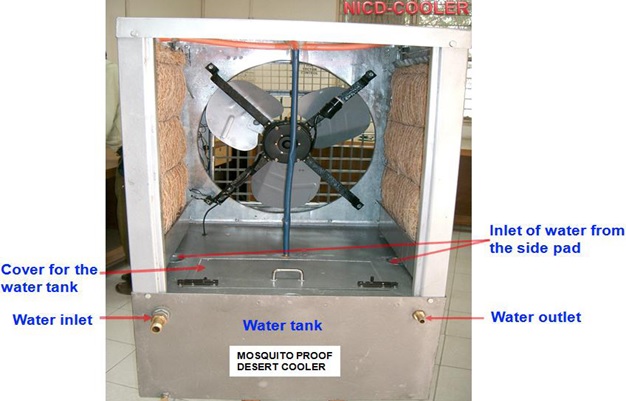
are found breeding in domestic/peri-domestic containers including desert coolers.
The conventional desert coolers are being used in many parts of the country
as a cooling device in houses, offices and industrial establishments during
the summer months. The conventional desert coolers hold water for long period
and they have become the potential breeding grounds for dangerous mosquitoes
in absence of adequate control efforts.
The NICD cooler is a patented item and registered with National Research Development Corporation (A DSIR enterprise, Ministry of Science and Technology) and is being manufactured and marketed by the 13 agencies.
-
Pooja Prasad, Sunita Patel, Priya Singh, Ashna Bhasin, Arti Bahl, Ranjan Das.
Advances in diagnosis of Dengue, Chikungunya, and Zika Virus-Infected
Aedes Mosquitoes: A review.
International Journal of Entomology Research.
2026; 11(3): 90-93.
View Publication
-
Pooja Prasad, Priya Singh, Sunita Patel, Ashna Bhasin, Arti Bahl,
Shaukat Kamal, Tanzin Dikid and Ranjan Das.
Evidence of Dengue and Chikungunya virus Co-circulation in field collected
Aedes populations across Delhi, India.
South Asian Journal of Parasitology.
2026; 9(2): 326-336.
View Publication
-
Somya Sharma, Priya Singh, Shweta Sharma, Sunita Patel, Shilpi Dhan,
P. Chandrasekaran, Abhay Kumar Sharma, Ved Parkash, Ashok Kumar,
Laxmi Narayan Boyat, Anand Kumar, Arun Chauhan, Namita Soni,
Siva Kamalakannan, Ajay Kumar Kumawat, Pooja Prasad, Iyyappan Velan,
Aathira V. Dev, Aswini Kumar, Vetrivel Bhaskar, Ashna Bhasin,
Diwakar Singh Dinesh, Tanzin Dikid, Arti Bahl and Ranjan Das.
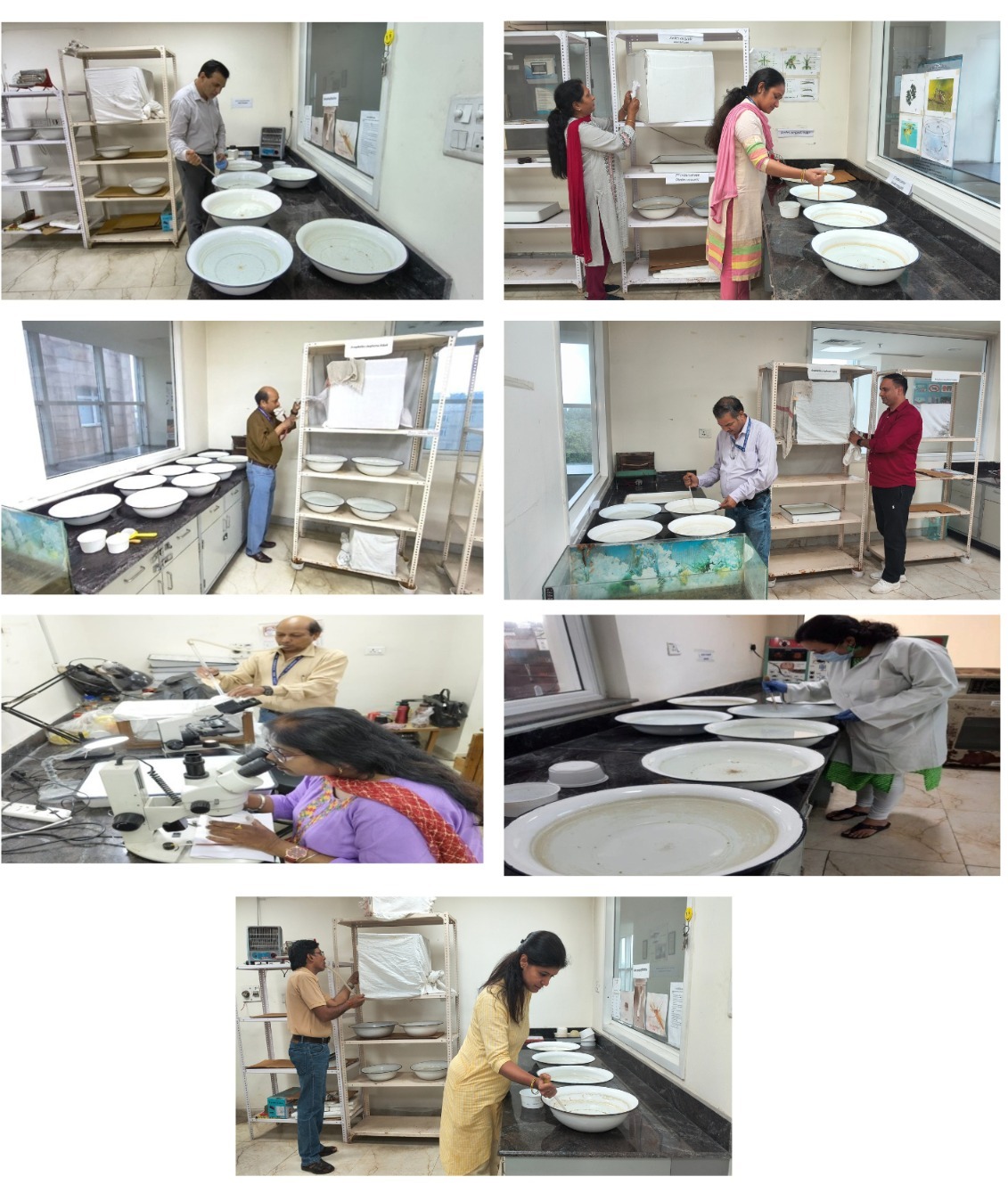
Integrated Approaches for Rearing of Vectors in Semi-Insectary Conditions.
International Journal of Current Microbiology and Applied Sciences.
2025; 14(7): 49-55.
View Publication
-
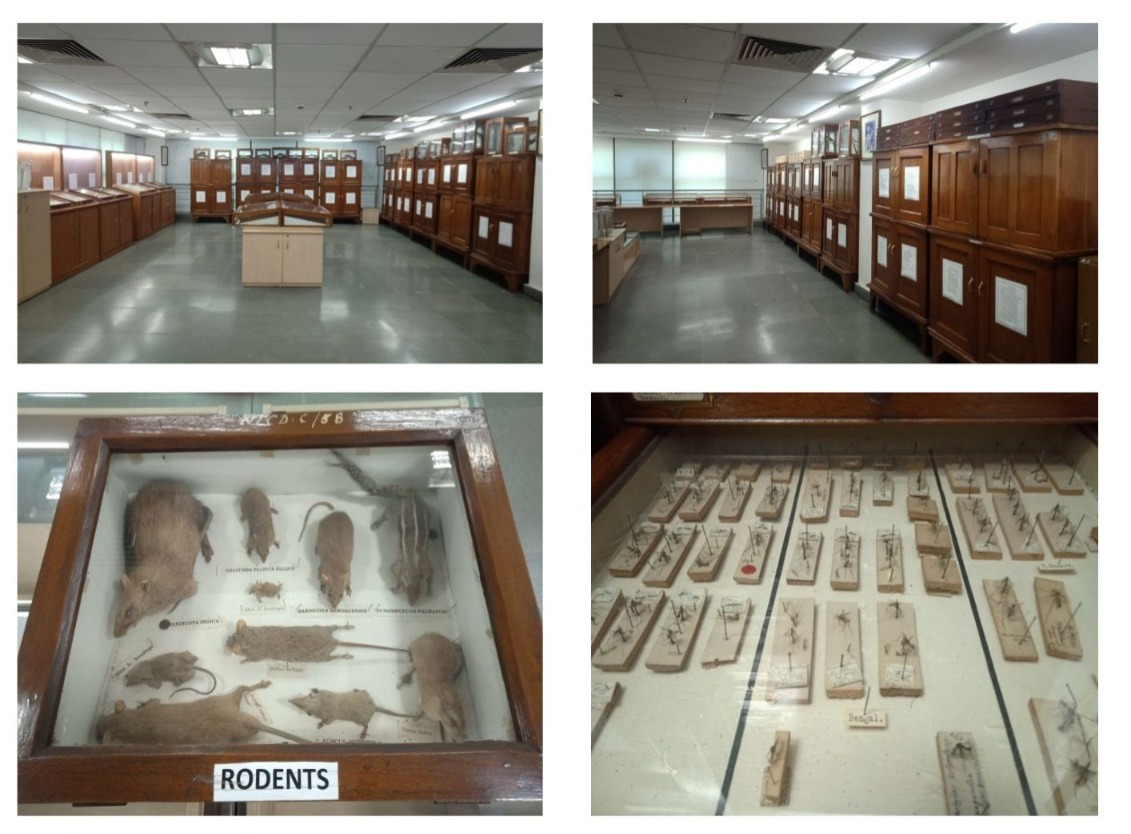
Ved Parkash, Sukhvir Singh, Abhay Kumar Sharma & Tanzin Dikid.
A Book on “An inventory of mounted specimens of public health importance
in Entomology Museum of National Centre for Disease Control, Delhi (India).”
Akinik Publication; 2024, 1-114.
-
Amar Nath Pandey, Arun Chauhan, Ved Parkash & Sukhvir Singh.
Horizontal distribution and larval habitat potential of invasive
Aedes mosquitoes in South Delhi, India during 2023.
Journal of Communicable Diseases.
2024; 56(1): 21-24.
-
Maneesha Sharma, Neeta Raj Sharma, Anu Bansal, Minhaj Ahmed Khan,
Jyoti Guleria, Ayan Roy, Shweta Kaushik, Gursharan Singh.
Global impact of mosquito-borne Alphaviruses on Humans: Their Spread
and Rehabilitation.
Journal of Communicable Diseases.
2023; 55(3): 93-110.
View Publication
-
Shweta Kaushik, Neeta Raj Sharma, Shashank Garg, Anu Bansal,
TG Thomas.
Larvicidal effects of Calotropis procera leaf extracts against
Aedes aegypti, vector of Dengue fever.
ENTOMON.
2022; 47(4): 415-420.
View Publication
-
Shweta Kaushik participated in an oral presentation on the topic
“Larvicidal effects of Calotropis procera leaf extracts against
Aedes aegypti” at the International Conference on Sustainability:
Life on Earth 2021 (ICS-LOE 2021), held on 17-18 December
2021 at Lovely Professional University, Punjab.
-
Shweta Kaushik participated in a poster presentation on
“Mosquito larvicidal properties of indigenous plants” at the
International Conference on Innovative Strategies for Sustainable
Water Management, held from 17-11-2017 to 18-11-2017 at
Lovely Professional University, Punjab.
-
Sunita Patel, AK Sharma Shilpi Dhan, Priya Singh, et.al. 2017. Dengue Vector Surveillance in and around Mormugao Port Trust (MPT) – Goa, India. Journal of Communicable Diseases, 49 (3): 4-8
-
Sharma AK, KumarK, Thomas TG and Singh SK. 2018. Ecto-parasites of rodents collected from International seaport, Gujarat (India) with special reference to Plague and Scrub Typhus transmission. Journal of Communicable Diseases, 50(4): 7-13.
-
Shweta Kaushik, Neeta Raj Sharma, TG Thomas, Abhay Kumar Sharma, Anu Bansal. 2019. Indigenous Plants and their Larvicidal Potential against Indian Mosquito Vectors: A Review. Journal of Communicable Diseases, 51(2): 59-72.
-
Anu Bansal, Neeta Raj Sharma, Atul K Upadhyay, Shweta Kaushik, TG Thomas. 2019. Evaluation of Carvacrol and its Receptor (Ubiquinone-c-reductase) as a Potential Anti-malarial Drug. Journal of Communicable Diseases, 51( 4): 16-20.
-
Sujeet K. Singh, S. K. Jain, S. N. Sharma and Sukhvir Singh. 2019. 70 Years of Indian Society for Malaria and Other Communicable Diseases towards public health in the country. Journal of Communicable Diseases,51 (1):29-33.
-
Rina Kumawat, T.G. Thomas, Sujeet Kumar Singh et al. 2019. Entomological Survey during Zika Virus Infection in Ahmedabad, Gujarat. Journal of Communicable Diseases, 51(1):12-17.
-
S N Sharma, Rina Kumawat, Sujeet Kumar Singh. 2019. Kyasanur Forest Disease: Vector Surveillance and its Control. Journal of Communicable Diseases, 51(3): 55-61.
-
S N Sharma, Ram Singh, Rina Kumawat, Sujeet Kumar Singh. 2019. Scrub Typhus: Vector Surveillance and its Control. Journal of Communicable Diseases, 51(3): 55-61.
-
S N Sharma, Ram Singh, Rina Kumawat, Sujeet Kumar Singh. 2019. Rodents as Public Health pests: Identification, Surveillance & its Management. Journal of Communicable Diseases, 51(3): 55-61.
-
Sweta Bhan, Pankaj U Ramteke, Amarpal Singh, Rina Kumawat and Abhay K Sharma. 2019. Entomological surveillance of Dengue vectors in Bareilly District of Uttar Pradesh, India. (Abstract No.-PP:15). Proceedings of the XIII Annual Conference of Indian Society for Malaria and other Communicable Diseases (29th November 2019 to 1st December 2019).
-
Shweta Kaushik, Neeta Raj Sharma, T.G. Thomas, Abhay Kumar and Anu Bansal. 2019. Indigenous plants and their Larvicidal potential against Indian Mosquito Vectors: A Review. Journal of Communicable Diseases, 51(2): 59-72.
-
Anu Bansal, Neeta Raj Sharma, Atul K Upadhyay, Shweta Kaushik and T.G. Thomas. 2019. Evaluation of Carvacrol and its receptor (Ubiquinone-c-reductase) as a potential Anti-Malarial Drug. Journal of Communicable Diseases, 51(4): 16-20.
-
S.N.Sharma and Sujeet Kumar Singh. 2020. Challenges and Threats due to deadly Corona virus in India and dealing with social vaccine (distancing) – the only vaccine. Journal of Communicable Diseases, 52(1): 7-13.
-
Sujeet K. Singh, S. K. Jain and S. N. Sharma. 2020. Prevention and Control of Covid-19 in Indian Perspective. Journal of Communicable Diseases, 5(1): 32-38.
-
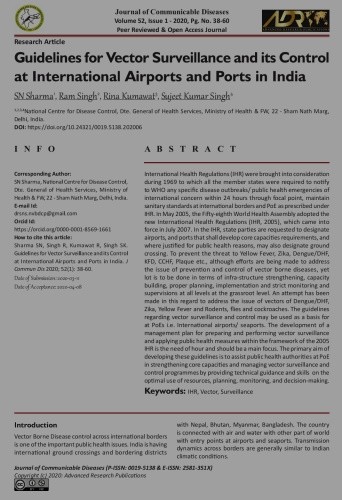
S. N. Sharma, Ram Singh, Rina Kumawat and Sujeet Kumar Singh. 2020. Guidelines for Vector Surveillance and its Control at International airports and ports in India. Journal of Communicable Diseases, 52(1): 38-60.
-
Sujeet K.Singh, S.K. Jain and S.N. Sharma. 2020. Situational Analysis and Trend of Covid-19 in India. Journal of Communicable Diseases, 52(2): 38-45.
-
AMKM Rao, ND Kanchana, SN Sharma. 2020. Sampling Model on Surveillance of COVID-19 virus among Human Populations. Journal of Communicable Diseases,52(2): 12-1
-
Kamal, Ramesh Chandra, KK Mitra and SN Sharma. 2020. An investigation into Outbreak of Malaria in Bareilly district of Uttar Pradesh, India. Journal of Communicable Diseases, 52(2): 1-11.
-
Rajendran R, Sheela Devi D, Anusree SB, Regu K, S N Sharma. 2020. Coronaviruses: The Most Dangerous Pathogen of Present Era. Journal of Communicable Diseases, 52(4): 17-28.
-
S.N. Sharma, Ram Singh, Rina Kumawat and Sujeet Kumar Singh. 2020. Vectors of CCHF: Prevention and its control. Journal of Communicable Diseases, 53(1): 22-26.
-
Ved Prakash; Sunita Patel; Sweta Bhan; TG Thomas J. 2020. Vector Surveillance for Dengue, Chikungunya, Zika Virus and Yellow Fever at Three Blocks of Pakud Districts of Jharkhand, India. Journal of Communicable Diseases, 52 (4): 1-4.
-
Amarpal Singh Bhadauriya, Pankaj U Ramteke, Abhay K Sharma, R.K Meena, Rina Kumawat, Sweta Bhan, Lalthazuali, Ram Singh and Arun Chouhan. 2020. Entomological Investigations of an outbreak of Japanese Encephalitis in three districts of Chhattisgarh, India in the year 2017. International Journal of Advanced Research, 8(2): 161-171.
-
Amarpal Singh Bhadauriya, Shilpi Dhan, Pankaj U Ramteke, Sweta Bhan, Lalthazuali, Rina Kumawat, Ram Singh, Arun Chauhan. 2020. Entomological Survey for Aedes Species at Deendayal Seaport, Kandla, Gujarat India during Pre-Monsoon Period, 2018. Journal of Communicable Diseases,52(4): 35-38.
-
Sujeet K. Singh, S. K. Jain, S. N. Sharma and Sukhvir Singh. 2019. 70 Years of Indian Society for Malaria and Other Communicable Diseases towards public health in the country. Journal of Communicable Diseases,51 (1):29-33.
-
Sweta Bhan, Lalthazuali, Abhay K Sharma, T.G. Thomas and Ram Singh. 2020. Entomological assessment of malaria outbreak in Bareilly and Budaun districts of Uttar Pradesh, India. International Journal of Mosquito Research, 7(5): 53-59.
-
Lalthazuali, Sweta Bhan, T. G. Thomas and Ram Singh. 2020. Post flood vector borne disease surveillance: An experience from Malappuram district of Kerala, India in 2018. International Journal of Mosquito Research, 7(5): 01-06.
-
Lalthazuali, Abhay Kumar Sharma, TG Thomas, Sweta Bhan, Amarpal Singh Bhadauriya, Pankaj U Ramteke, Rina Kumawat, Ram Singh. 2020. Entomological Survey of Vectors of Scrub Typhus in Haulawng, Lunglei district, Mizoram, India. Journal of Communicable Diseases, 52(2): 69-73
-
Lalthazuali and Abhay Kumar Sharma. 2020. Entomological Survey for Vectors during Scrub Typhus outbreak in Haulawng, Lunglei district, Mizoram, India.(Abstract No.-PP:16). Proceedings of the XIII Annual Conference of Indian Society for Malaria and other Communicable Diseases (29th November 2019 to 1st December 2019).
-
Sunita Patel, Ram Singh, Sujeet Kumar Singh et.al. 2020. A study on the influence of climatic factors on the prefential breeding places of Aedes, the Dengue vector, in Delhi, India. International Journal of Mosquito Research, 7(4): 95-104.
-
VedParkash, Sunita Patel, Sweta Bhan, TG Thomas. 2020. Vector Surveillance for Dengue, Chikungunya, Zika Virus and Yellow Fever at Three Blocks of Pakur Districts of Jharkhand, India. Journal of Communicable Diseases, 52(4): 77-80.
-
S.N.Sharma, B.R. Mane, Mahendra Sonar, Sanket Kulkarni , Raishuddin, Rina Kumawat, Ram Singh ,S.K. Singh. 2021. Entomological Survey for CCHF Vectors in Palghar District of Maharashtra. Journal of Communicable Diseases, 53(1): 10-14.
-
Kaushal K, Dhuria M, Mariam W, Jain S K, Singh S, Garg S, Chauhan A. Experience of setting up of Control room for COVID-19 at NCDC, New Delhi. Journal of Family Medicine and Primary Care, Vol 10, No. 3, March 2021, pp. 1082-1085
-
Sharma SN, Kamalakannan S, Sharma AK and Chandrasekaran P. NCDC assists Uttarakhand Government in preparedness against Vector Borne Diseases (VBDs) at Kumbh Mela, Haridwar, April 2021. NCDC Newsletter. 2021; 10(2): 10-11.
-
SN Sharma, Rina Kumawat, SK Singh. 2022. Entomological Sampling Strategy, Sampling Tools and Analytical Techniques with regard to Vector Borne Diseases: Indian Perspective. Journal of Communicable Diseases, 54(1): 117-123.
-
SN Sharma, Rina Kumawat, SK Singh. 2022. Mass Gathering and Population Movement in India: Possible Risk of Vector–Borne Diseases. Journal of Communicable Diseases, 54(2): 49-54