Home › National One Health Programme for Prevention and Control of Zoonoses (NOHP-PCZ)
National One Health Programme for Prevention and Control of Zoonoses (NOHP-PCZ)
Introduction
The One Health Programme for Prevention and Control of Zoonoses (NOHP-PCZ) is a Central Sector Scheme of the Ministry of Health and Family Welfare, Government of India, implemented through the National Centre for Disease Control (NCDC), Directorate General of Health Services (DGHS).
The programme was approved in 2013 under the 12th Five-Year Plan as the Strengthening Inter-Sectoral Coordination for Prevention and Control of Zoonotic Diseases scheme and was subsequently renamed NOHP-PCZ.
Zoonotic diseases require coordinated action across human, animal and environmental health sectors.
NOHP-PCZ adopts a one Health approach to strengthen inter-sectoral coordination, build technical and laboratory capacities,
improve surveillance and data sharing, support joint outbreak investigation and promote community awareness for the prevention and control of emerging and re-emerging zoonotic diseases.
The programme seeks to progressively Institutionalize One Health mechanisms at National, State,
District and grassroots levels by bringing together stakeholders from the health, veterinary, wildlife, environment and other relevant sectors on a common platform.
Vision
To institutionalize structural mechanisms for a One Health approach in the country at the National, State, District, Block and village levels.
Mission
To bring all stakeholders, from policymakers to frontline workers, onto a One Health platform with a shared vision and common goals.
Components of the programme
The NOHP-PCZ is implemented through six key components:
- Component A: Institutionalization of One HealthStrengthening One Health structures and inter-sectoral coordination mechanisms at the national,
State, district and grassroots levels, including coordination among human health, veterinary, wildlife, environment and other relevant sectors.
- Component B: Integrated Capacity Building Building capacities on zoonoses through a multidisciplinary network of Regional Coordinators, One Health institutions and partner organizations. This includes joint trainings,
workshops and hands-on laboratory training, along with strengthening diagnostic capacities for priority zoonoses and emerging and re-emerging infectious diseases.
- Component C: Integrated Surveillance of ZoonosesStrengthening surveillance of zoonotic diseases through systematic collection, analysis and sharing of information across sectors,
including establishment and strengthening of sentinel surveillance sites for assessing the spatial and temporal trends of zoonotic diseases.
- Component D: Integrated Community OutreachPromoting prevention and control of zoonoses at the grassroots level through community engagement,
awareness generation and joint capacity building of frontline health, veterinary and other relevant workers, with particular focus on high-risk and vulnerable populations.
- Component E: Advocacy and Risk CommunicationStrengthening advocacy, Information, Education and Communication (IEC),
and risk communication activities to improve awareness and promote appropriate preventive practices related to zoonotic diseases.
- Component F: Operational ResearchPromoting multidisciplinary research on zoonoses to address knowledge gaps related to disease burden, spatial distribution,
transmission dynamics and effectiveness of interventions, thereby supporting evidence-based programme planning and implementation.
Major Activities and Achievements
State-level Zoonoses Committees (SLZCs) constituted in 35 States/Uts, providing a formal platform for coordination among the human health,
animal husbandry, wildlife, forestry and environmental sectors.
State One Health Action Plans developed and operationalized in Odisha and Rajasthan, providing a structured framework for coordinated One Health action.
Sector Connect training programmes conducted regularly across States to strengthen intersectoral coordination, collaboration and operational linkages among relevant departments.
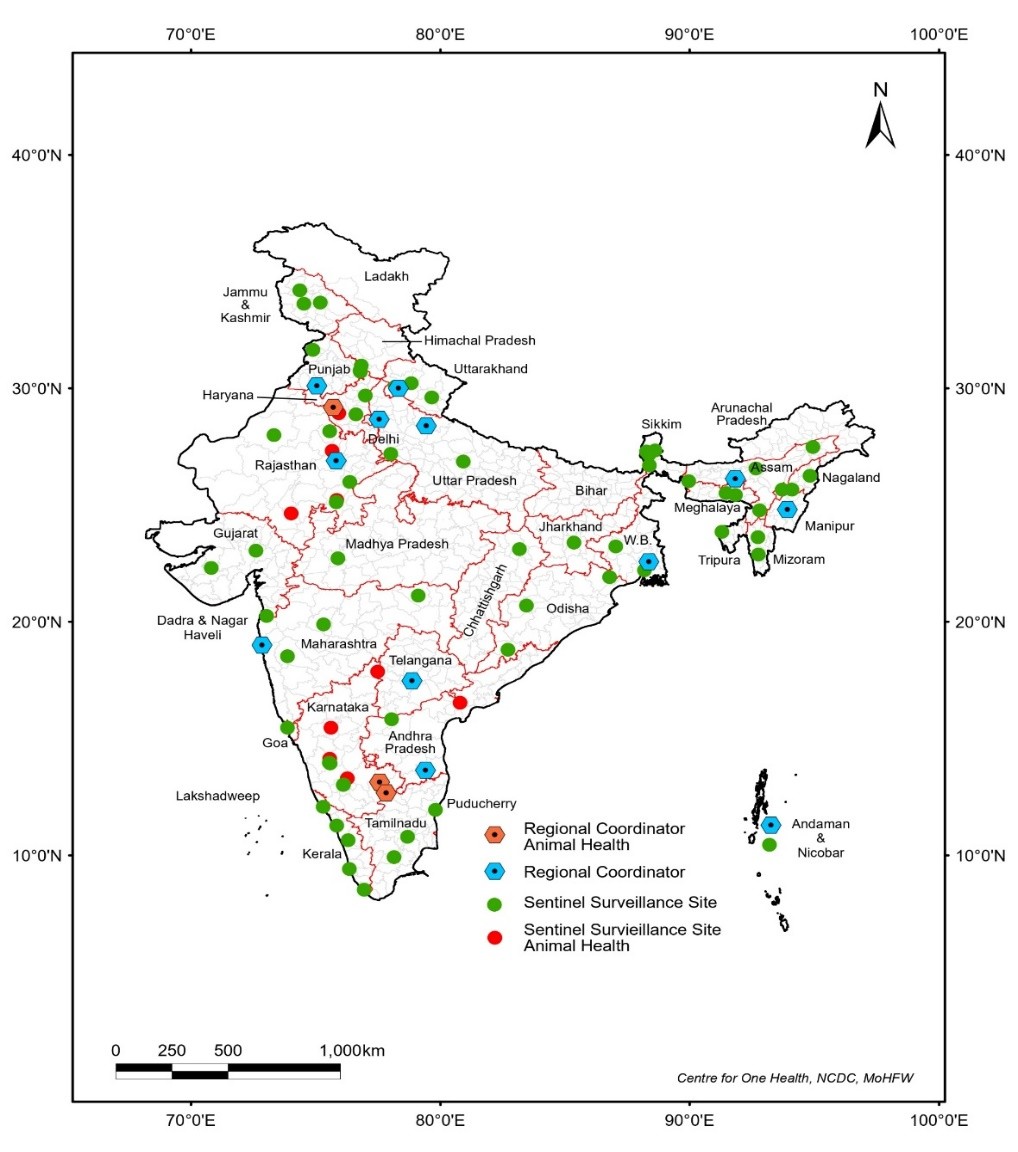
Integrated laboratory surveillance network comprising 86 Sentinel Surveillance Sites supported by 18 Regional Coordinators operationalized across the country to strengthen surveillance of priority zoonotic diseases across human and animal health sectors.
Ten Learning Resource Packages (LRPs) developed on priority zoonotic diseases to support standardized capacity building and technical training.
NOHP-PCZ onboarded onto the Integrated Health Information Platform (IHIP) to support digital surveillance, reporting and data integration for zoonotic diseases.
Activities undertaken in last one year i.e. 2018-19
a) Intersectoral coordination
To institutionalize the “ONE HEALTH” approach at National level – Collaboration with DADF, Ministry of Agriculture and Farmer Welfare (MoA & amp ;FW) for development of technical guidelines for animal component of rabies control has been done. MoU is proposed to be signed between DADF, MoA & amp; FW, MoH & amp; FW, Wild life institute of India for prevention and control of Zoonotic Disease in India including rabies. Preliminary meeting on Proposal for signing of MoU between Technical Stakeholders for Strengthening Inter-sectoral Coordination for Prevention and Control of Zoonotic Diseases in India held in February.
b) State & District level initiatives
14 States constituted State Level Zoonosis Committee (SLZC) for intersectoral coordination for prevention and control for zoonosis. Formation of district level committee zoonosis committee is under progress . Follow up is being done with rest ot
c) Technical support activities
Organized a two day “National Multi Stakeholder Technical Workshop for strengthening inter-sectoral coordination for prevention and control of zoonotic diseases” in Joint collaboration with DADF, Ministry of Agriculture and CDC India on 27th and 28th February 2019.SOPs for priority zoonosis ( Rabies, Anthrax, Scrub typhus, Leptospirosis etc.) are being formulated with the consultation of stakeholders and State
d) IEC activities
Communication was made with all states/UTS to observe World zoonosis day observed for raising awareness of medical and vet. Professional on 6 th July 2018 and few states undertook activities at state and district level for raising awareness among professionals and general community. Division also participated in activity organized by for at Safdarjung medical Delhi for generating awareness among medical and vet, students on 6 the July