NCDC | MOHFW
Skip to Main Content Sitemap Screen Reader Access

National Centre for Disease Control

Directorate General of Health Services, Ministry of Health & Family Welfare
Government of India

How to Reach NCDC Guest House & PG Hostel NCDC Newsletter Epi-Dis-PHERE-Publication of Health Resilience Quarterly e-journal of National Centre for Disease Control NCDC NPHICON 2024 Media Gallery Citizen Charter Grievance RTI Help Feedback
NCDC Header
← Back

National Biomonitoring Programme for Chemical Toxicants

About NBPCT Programme

As the designated nodal agency for chemical surveillance, the National Centre for Disease Control (NCDC), Ministry of Health and Family Welfare, Government of India, is in the process of initiating the National Biomonitoring Programme for Chemical Toxicants.

This programme is in line with India’s strategic effort to strengthen chemical risk management and global commitments, obligations and frameworks, including:

  • The International Health Regulations (IHR 2005), which call for core public health capacities to detect, assess, and respond to chemical events;
  • The Global Framework on Chemicals (GFC) beyond 2020, particularly contributing to Targets A1, A6, B5, and B7 on health, risk reduction, exposure prevention, and surveillance;
  • The Stockholm, Minamata, and Basel Conventions, which guide global action on persistent toxicants, mercury, and waste management.

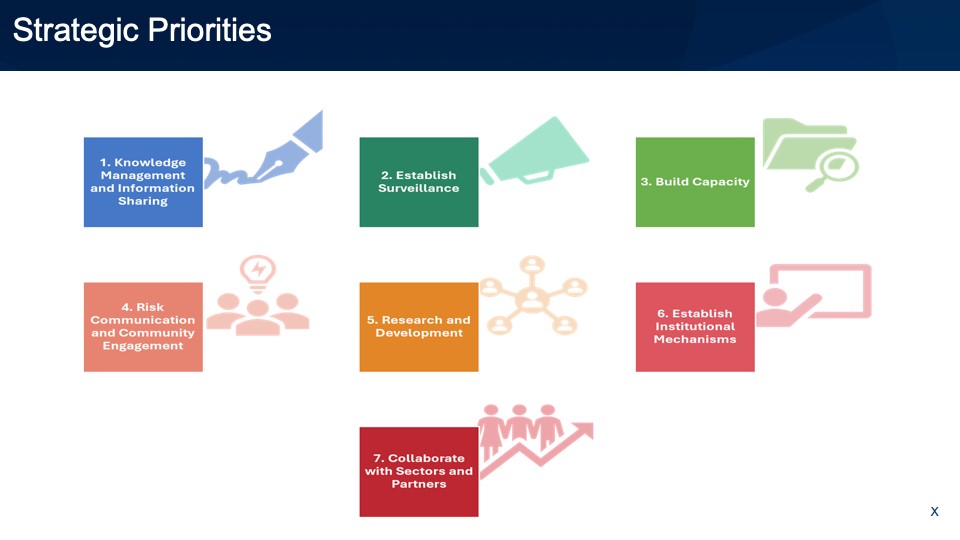
Key Strategic priorities of the programme are:

NBPCT Strategy

By adhering to global best practices and fostering partnerships across sectors—environment, health, industry, and academia—the programme intends to inform evidence-based public health policy, particularly for high-risk and vulnerable populations.

Progress So Far

Workshops
  • 1st National Stakeholder Engagement Workshop (March 14–15, 2024)
  • 2nd National Consultative Workshop with 10 priority states and partners (February 24, 2025)
  • CD Alert on Lead
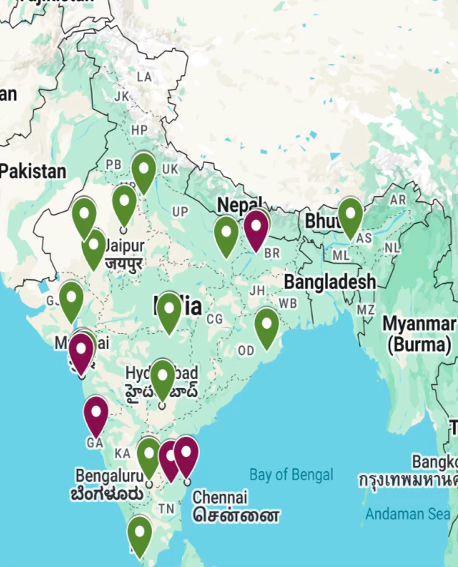
  • List of Poison Information Centres
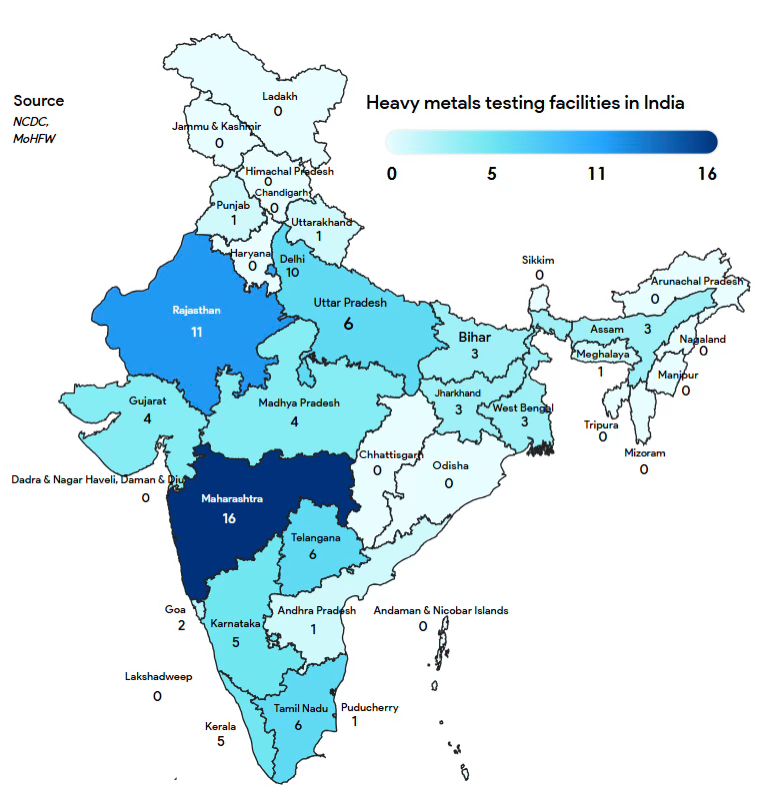
  • Labs with Heavy Metal Testing:As part of this programme, a nationwide mapping exercise is underway to assess regional and national laboratory capacities for testing human and environmental samples for chemical toxicants. If your laboratory has the capacity to conduct such testing, you are kindly requested to submit your details through the Google Form link provided below: https://docs.google.com/forms/d/e/1FAIpQLSeQ46sA5XVOo3Tk-xxhjdN9Qb_tC_LSHBUNXWLSEtLEbPasag/viewform
  • Lab Mapping Lab Capacity
  • PowerPoint Presentation on National Biomonitoring Programme for Chemical Toxicants

  • National Biomonitoring Programme for Chemical Toxicants IHIP Learning Portal Link : https://ihiplearning.in/bpct/#/home-page

  • Field user: Field investigators will be assigned a unique user ID and login credentials to access the NBPCT module on IHIP. They will be responsible for entering demographic, biological, and source exposure-related data. Between the biological and source exposure data user can click yes for both or either in case only one type (either biological or only source data). Post-primary screening, if biological or environmental samples are collected and further sent to labs for analysis, the investigator can designate the appropriate laboratory from the list of mapped labs and can mark labs to further add data in the same for directly. All mapped labs will have a unique user id and password to further add data in the lab interface.
  • Lab user: Lab users will enter chemical analysis results of biological or environmental or both samples collected from the field.
  • The State and Centre user interface allows the State and Centre users to view the data and take further actions.
  • To request for login id and password to access the NBPCT portal, kindly send a request to biomonitoringindia@gmail.com

Activities

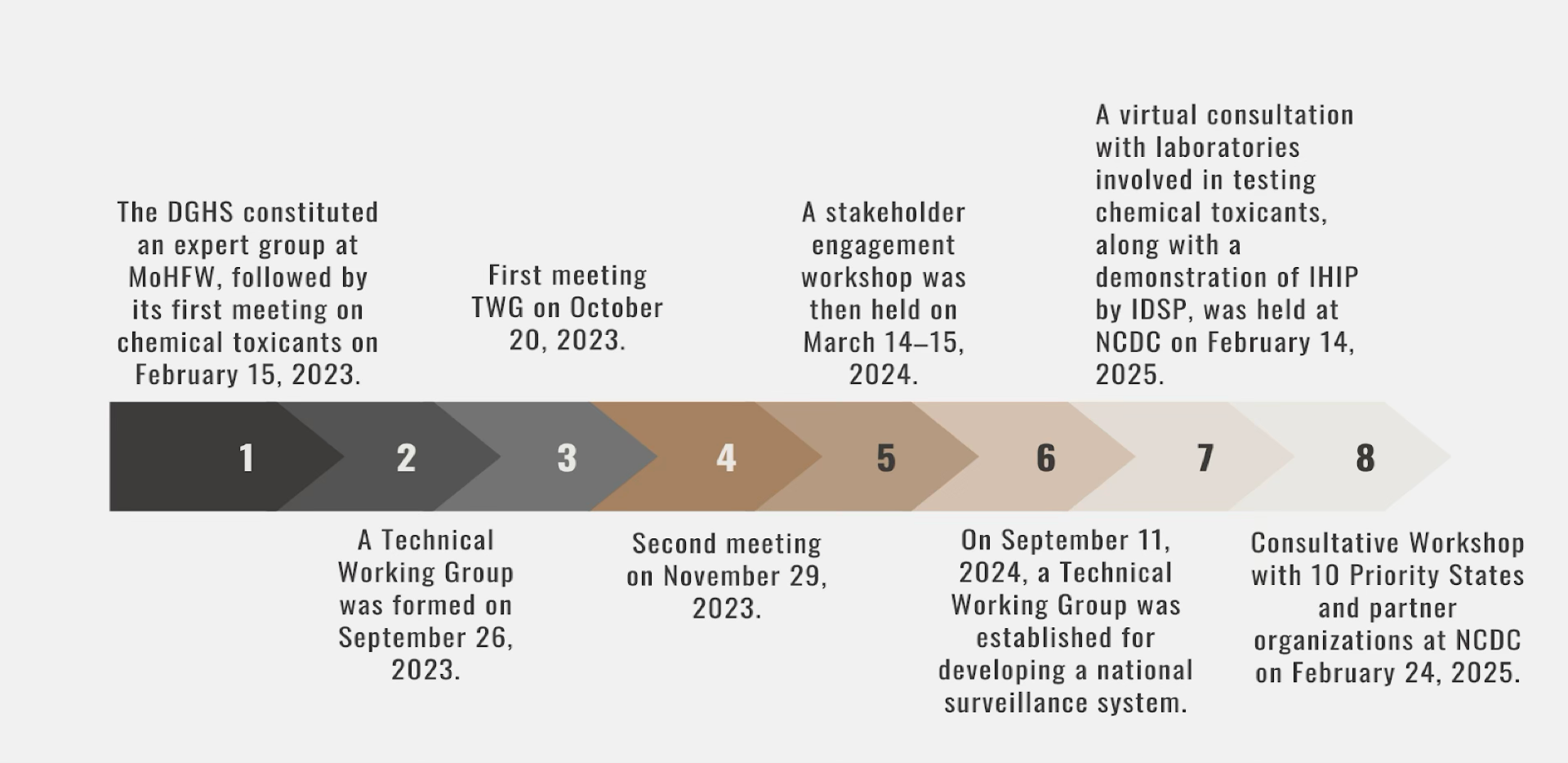
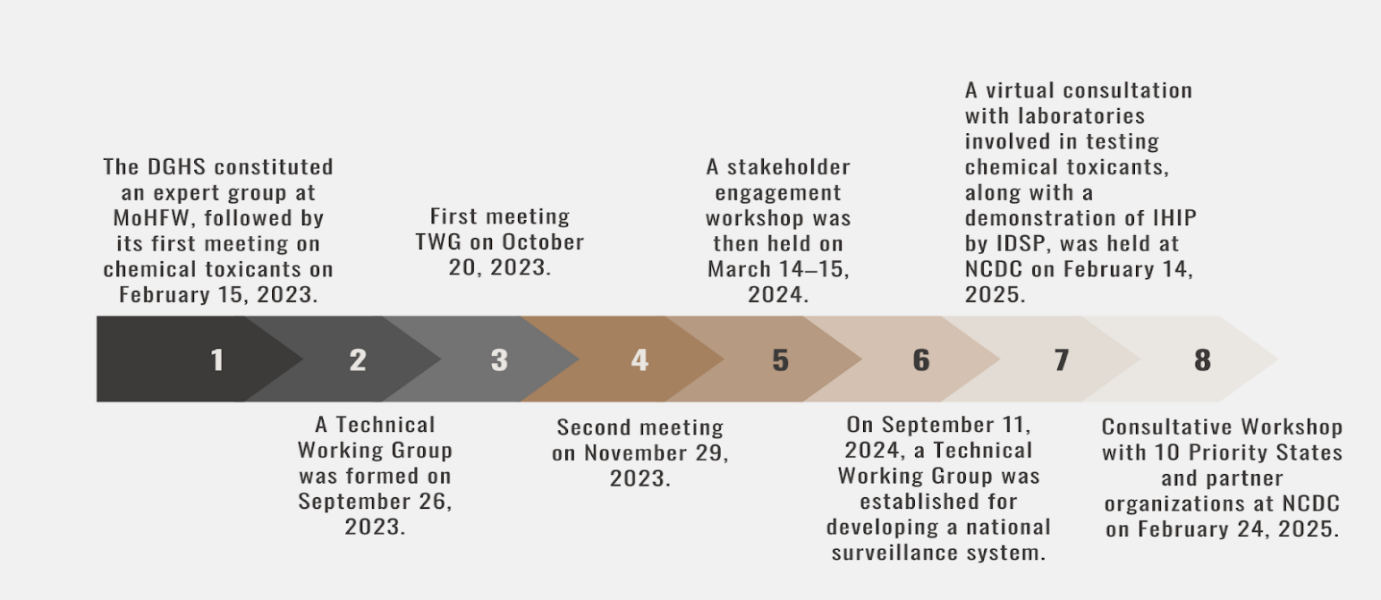
Feb 15, 2023

The DGHS constituted an expert group at MoHFW, followed by its first meeting on chemical toxicants on February 15, 2023.

Sep 26, 2023

Technical Working Group (TWG) was formed.

Oct 20, 2023

First meeting of the Technical Working Group.

Nov 29, 2023

Second meeting of the Technical Working Group.

Mar 14–15, 2024

Stakeholder engagement workshop conducted.

Sep 11, 2024

TWG established for developing a national surveillance system.

Feb 14, 2025

A virtual consultation with laboratories involved in testing chemical toxicants, along with a demonstration of IHIP by IDSP

Feb 24, 2025

Consultative Workshop with 10 Priority States and partner organizations at NCDC

Workshop Image 1 Workshop Image 2

Key Highlights & Ongoing Activities

  • Chemical toxicants testing capacity assessment and laboratory mapping – ongoing (via Google Forms).
  • Virtual consultation with laboratories conducted on Feb 14, 2025.
  • First stakeholder workshop held in March 2024 with participation from ministries, medical colleges, and NGOs and led to formulation of 7 action tracks with multiple short, medium, and long-term activities under each action track
  • Webpage being developed on IHIP as knowledge resource and for data compilation- State-level studies and researchers encouraged to share data as excel sheets and directly on IHIP once it goes live
  • Second Consultative working on NBPCT held on 24th of February 2025- 10 states participated and shared details about the work done in each state.

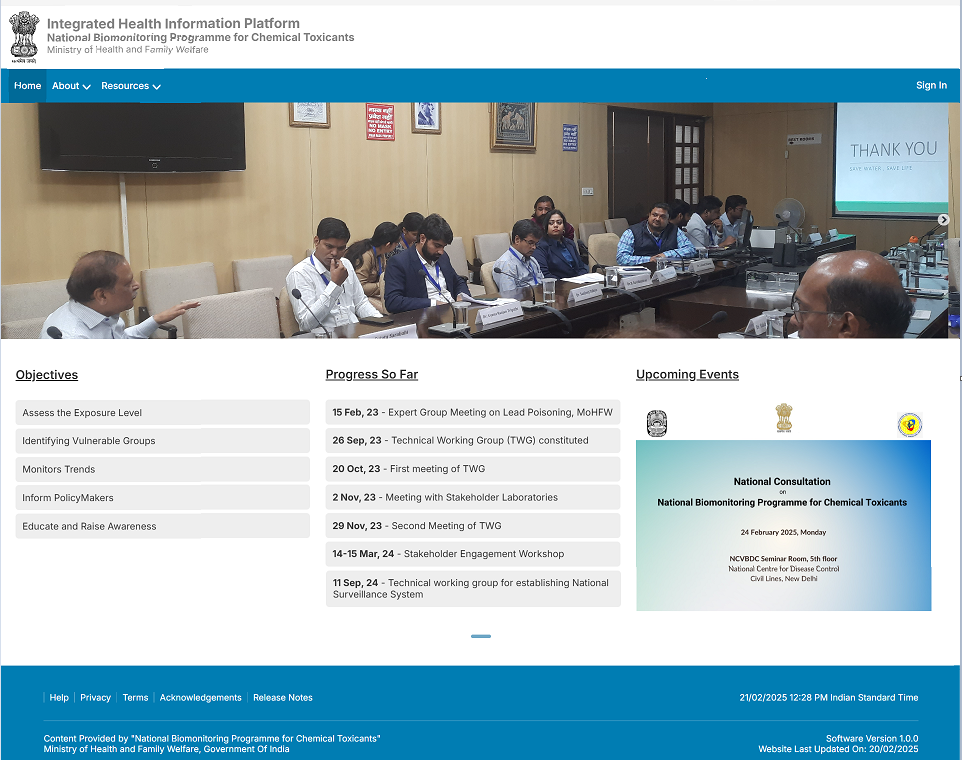
National Biomonitoring Programme for Chemical Toxicants module on IHIP-For Data collection and capacity building


IEC Material


Unit/Laboratories


List of Poison Information Centers

Sl. No. Institution Name District State Type Contact Location
1 Christian Medical College Hospital, Vellore Vellore Tamil Nadu Governmental Website View Map
2 JSS College of Pharmacy, Ooty Ooty Tamil Nadu Governmental Website View Map
3 JIPMER Drug Information Center, Pondicherry Puducherry Puducherry Governmental Website View Map
4 Pharma Information Center, Chennai Chennai Tamil Nadu Governmental Website View Map
5 Poison Control, Training, and Research Center, Government General Hospital, Chennai Chennai Tamil Nadu Governmental Website View Map
6 Sri Ramachandra Hospital, Chennai Chennai Tamil Nadu Governmental Website View Map
7 Sri Ramakrishna Mission Hospital, Coimbatore Coimbatore Tamil Nadu Governmental Website View Map
8 Toxicology and IMCU Unit, Government General Hospital, Chennai Chennai Tamil Nadu Governmental Website View Map
9 RIPER Poison and Drug Information Center, RDT Hospital, Bathalapalli Bathalapalli Andhra Pradesh Governmental Website View Map
10 Alcohol and Drug Information Center (ADIC), Trivandrum Thiruvananthapuram Kerala Governmental Website View Map
11 Poison Control Center, Amrita Institute of Medical Sciences, Cochin Kochi Kerala Governmental Website View Map
12 Trivandrum Medical College, Trivandrum Thiruvananthapuram Kerala Governmental Website View Map
13 Bowring and Lady Curzon Hospital, Bangalore Bangalore Karnataka Governmental Website View Map
14 JSS College of Pharmacy, Mysore Mysore Karnataka Governmental Website View Map
15 Drug Information Center (KSPC), Bowring and Lady Curzon Hospital, Bangalore Bangalore Karnataka Governmental Website View Map
16 Drug Information Center (KSPC), Victoria Hospital, Bangalore Bangalore Karnataka Governmental Website View Map
17 Jawaharlal Nehru Medical College Hospital (JNMC), Belgaum Belgaum Karnataka Governmental Website View Map
18 Kasturba Medical College (KMC), Manipal Manipal Karnataka Governmental Website View Map
19 Kempagowda Institute of Medical Sciences (KIMS), Bangalore Bangalore Karnataka Governmental Website View Map
20 KSPC, Bangalore Bangalore Karnataka Governmental Website View Map
21 Bulletin on Drug and Health Information (BIDI), Kolkata Kolkata West Bengal Governmental Website View Map
22 CDMU Documentation Center, Calcutta Kolkata West Bengal Governmental Website View Map
23 N.R.S. Medical College and Hospital, Calcutta Kolkata West Bengal Governmental Website View Map
24 Poison Information Centre, R.G. Kar Medical College, Kolkata Kolkata West Bengal Governmental Website View Map
25 Department of Pharmacy Practice, NIPER, Chandigarh Chandigarh Chandigarh Governmental Website View Map
26 National Poisons Information Centre (NPIC), AIIMS, New Delhi New Delhi Delhi Governmental Toll-Free: 1800 116 117
Tel: 011-26589391 Website
View Map
27 Poison Information Center, ICMR-National Institute of Occupational Health, Ahmedabad Ahmedabad Gujarat Governmental Website View Map
28 Poison Information Centre, AIIMS Bhopal, Madhya Pradesh Bhopal Madhya Pradesh Governmental Website View Map
29 Drug and Poison Information Center (DPIC), P. D. Hinduja Hospital, Mumbai Mumbai Maharashtra Non-Governmental Tel: 022-24464600 Website View Map

State-level Initiatives

Sl. No. State-level Initiative Stakeholders
1 Tamil Nadu presented the methodology and preliminary findings of its statewide study on Blood Lead Levels (BLLs) among children (1-6 years) and pregnant women cross seven districts using capillary blood testing. The study identified key exposure sources, including industrial emissions, contaminated consumer products, and household environments, using home-based assessments. Directorate of Public Health, SRIHER, Vital Strategies, Pure Earth, UNICEF
2 Bihar undertook a large-scale surveillance study across eight districts. Findings revealed that 90% of children tested had BLLs exceeding the safe limit, with turmeric contamination being a critical concern. The state identified challenges such as limited laboratory capacity and lack of public awareness, underscoring the need for expanded testing infrastructure, stricter consumer product regulations, and targeted public health campaigns. Directorate of Health & Family Welfare, Bihar, Mahaveer Cancer Sansthan, Vital Strategies, Pure Earth, UNICEF
3 Jharkhand has adopted a Convergent Action Model linking health, environment, and industry departments and has formed a State Task Force (STF) with Rajendra Institute of Medical Sciences, Ranchi (RIMS Ranchi), acting as secretariat. Priorities include improving intersectoral coordination, expanding environmental surveillance, improving enforcement of regulations, and strengthening laboratory capabilities. Directorate of Health & Family Welfare, Jharkhand, RIMS Ranchi, USAID, IPE Global, Pure Earth, UNICEF
4 Uttar Pradesh outlined its multi-pronged strategy for addressing chemical toxicants. Key efforts include youth engagement initiatives, collaboration with professional bodies, interdepartmental coordination using existing platforms, and evidence-generation activities. The state aims to complete a comprehensive assessment of lead exposure across the state by September 2025, leading to policy and regulatory recommendations by year-end. Department of Health & Family Welfare, RML Lucknow, World Bank, IHAT, UNICEF
5 Maharashtra state initiative focuses on strengthening health system capacity, establishing working groups for improved coordination, enhancing laboratory infrastructure, and implementing home-based assessments to identify lead exposure sources. Department of Health & Family Welfare, SHSRC, AIIMS Nagpur, Vital Strategies, Pure Earth

Technical Resources

Contact Us

Full Mailing Address

National Centre for Disease Control
Division of Public Health Preparedness & NCD
22, Sham Nath Marg, Delhi – 110054

Dr. Meera Dhuria

Joint Director and Head
Division of Public Health Preparedness and Non-Communicable Diseases, NCDC

Email: meera.dhuria@gov.in

Dr. Priyanka Kundra

Senior Medical Officer
Division of Public Health Preparedness and Non-Communicable Diseases, NCDC

Email: priyanka.kundra@lhmc-hosp.gov.in