Activities
1. Field Epidemiology Training and Capacity Building Programmes:
The Epidemiology Division, National Centre for Disease Control (NCDC) functions as a WHO Collaborating Centre for Epidemiology and Training, supporting capacity building, surveillance strengthening, and outbreak preparedness. The Division contributes to regional and global public health efforts through technical expertise, training programmes, and collaborative research.
Epidemic Intelligence Services (EIS) Training Programme (Advanced-FETP):
he Ministry of Health and Family Welfare, Govt. of India, launched the Epidemic Intelligence Service (EIS) Programme at National Centre for Disease Control (NCDC),
Delhi in 2012 on the lines of the programme of the US Centers for Disease Control and Prevention (CDC), Atlanta, USA. This two-year programme is designed to provide high quality training to public health professionals with skills in epidemiology necessary for public health actions including surveillance, effective and rapid response to any public health event or crisis. This training is offered to nominated candidates of state health departments and self-sponsored mid-level public health professionals.
The programme is now linked to a Masters in Applied Epidemiology (MAE) degree from Guru Gobind Singh Indraprastha University, Delhi.
Further details of the programme are available at:
Click HereIntermediate Field Epidemiology Training Programme (I-FETP):
The Intermediate Field Epidemiology Training Programme (I-FETP) was initiated in 2024 under PM-ABHIM with technical support from CDC, targeting mid-level, state-sponsored public health officers/officials.
The programme is designed as a one-year, on-the-job epidemiology training programme with hands-on field assignments and close mentoring to provide skill-based experiential learning with a focus on surveillance, outbreak investigation, data analysis and evidence-based public health action. It equips epidemiologists to prevent, detect, respond to and communicate about public health threats
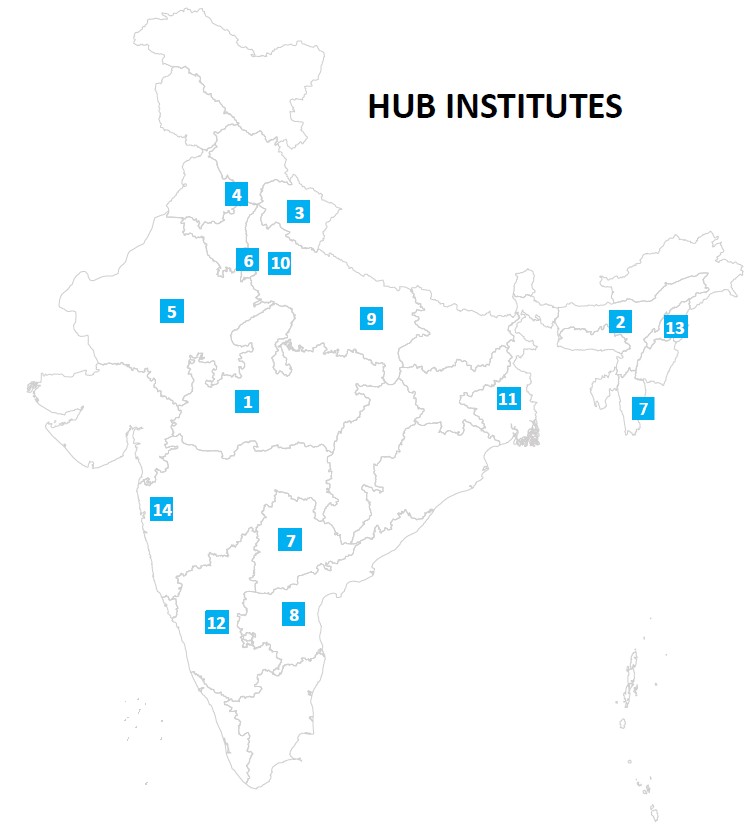
The programme was initially implemented through two national hubs—the National Institute of Public Health Training & Research (NIPHTR), Mumbai, and the All India Institute of Hygiene & Public Health (AIIHPH), Kolkata. 27 participants have graduated till date. The third cohort commenced on 13 July 2026, with 247 mentees from 31 States/UTs enrolled across 14 institutional hubs, marking a significant expansion of the programme's reach.
| S. No. |
Institutes |
| 1 |
AIIMS, Bhopal (MP) |
| 2 |
GMC&H, Guwahati (Assam) |
| 3 |
AIIMS, Rishikesh (Uttarakhand) |
| 4 |
PGI, Chandigarh |
| 5 |
SIHFW, Jaipur (Rajasthan) |
| 6 |
NIHFW, Delhi (Delhi) |
| 7 |
PHFI, Hyderabad (Telangana) |
| 8 |
AIIMS, Mangalagiri (AP) |
| 9 |
AIIMS, Gorakhpur (UP) |
| 10 |
RHFWTC, Meerut (UP) |
| 11 |
AIIHPH, Kolkata (WB) |
| 12 |
NIVEDI,Bangalore (Karnataka) |
| 13 |
RIMS, Imphal (Manipur) |
| 14 |
NIPHTR, Mumbai (Maharashtra) |
SectorConnect Field Epidemiology Programme in One Health (FEPOH)
The SectorConnect initiative has been conceptualized by the National Centre for Disease Control, MoHFW and DAHD, MoFAHD, GoI to strengthen the collective capacity and build a network of professionals across various health-related sectors for an integrated response for robust disease surveillance, investigation, and outbreak response at the field level. FEPOH is an on-the-job multi-sectoral training program of 3 months designed for in-service professionals who are part of the rapid response teams from health and allied sectors at the district level. The first batch was conducted in December 2023 in Gujarat.
WHO Field Epidemiology Training programme (FETP)
Field Epidemiology Training Programme (FETP) for Medical Officers:
It is a tailor-made programme for medical personnel from countries of South East Asia Region to strengthen the epidemiological skills. The training covers modules on principles of epidemiology, introduction to biostatistics, disease surveillance, outbreak investigation and response, role of the laboratories in public health, emerging infectious diseases, communication and health promotion, international health regulation, basic computer applications, and field practice.
Paramed FETP:
The division conducts one-month training programme every year for Paramedical workers from the countries of South East Asia Region in prevention and control of communicable diseases. This training programme aims at enhancing epidemiological skills of paramedical health workforce in the region for rapid response during communicable diseases outbreaks.
2. Academic Programme Programmes:
Master of Public Health (Field Epidemiology)
The Master of Public Health (Field Epidemiology) [MPH (FE)] is a unique, need-based two-year programme initiated in 2006 and affiliated with Guru Gobind Singh Indraprastha University (GGSIPU), Delhi, leading to a two-year Master’s degree (four semesters). The programme provides advanced-level field epidemiology training aligned with career pathways and develops core competencies in field epidemiology, disease surveillance, outbreak preparedness and response, public health laboratories, biostatistics, health management, health promotion, public health entomology, and planned research, preparing graduates to address complex public health challenges. The current intake for MPH programme is 20. Further details of the programme is available on GGSIPU website
|
Brief details of various capacity building programmes in Epidemiology Division
|
|
Name
|
Nos Trained
|
Eligible candidates
|
Duration
|
|
EIS Training
|
136
|
State and self-sponsored
|
2 years
|
|
MPH (FE)
|
112
|
Entrance based selection -
(Medical, ISM, BDS, Nursing)
|
2 years
|
|
Intermediate FETP
|
27
|
Epidemiologist from State health departments
|
1 Year
|
Regional FETP for
Medical Officers
|
316
|
Medical Officers from SEAR
|
3 months
|
|
Paramed FETP
|
251
|
Paramedics from SEAR
|
4 weeks
|
Frontline FETP/
Sector Connect
|
951
|
Epidemiologist, Microbiologists, Veterinary,
Data managers and other officials
|
3 contact sessions in 3 months
|
3. Unit for Antimicrobial surveillance consumption:
National Centre for Disease Control, New Delhi is the nodal agency for the National Programme on AMR Containment, which encourages rational antibiotic use. One of the objectives of this programme is to carry out surveillance of antibiotic usage in healthcare settings across India. Epidemiology division supports the programme by conducting:
• Monitoring of antimicrobial consumption trends at NAC-NET sites
• Point Prevalence Surveys of Antibiotic consumption at NAC-NET sites
4. Outbreak investigations
The Epidemiology Division plays a critical role in outbreak investigations across all regions of the country, operating as part of multidisciplinary central teams and the National Joint Outbreak Response Teams in close coordination with States/UTs and national programmes. EIS officers are also routinely deployed to support and lead field investigations, surveillance strengthening, and response activities. Over the past decade, the division has supported investigations of more than 100 outbreaks spanning a wide range of public health events, including Nipah virus disease, Zika virus infection, COVID-19, Crimean-Congo haemorrhagic fever (CCHF), Acute Encephalitis Syndrome (AES), poisoning incidents, vector-borne diseases, zoonotic diseases, anthrax, and vaccine-preventable diseases (VPDs), contributing to evidence-based control measures and policy actions.
5. Preparation of technical documents
The division has been actively engaged in knowledge generation and dissemination through the development of technical documents and training resources, including CD Alerts, the NCDC Newsletter, standardized checklists for outbreak investigations, training modules, and materials for the 3-month FETP, along with guidance on surveillance and control of communicable diseases. It has also made sustained academic contributions through the supervision of theses and dissertations and the publication of research papers in national and international journals, strengthening the evidence base for public health practice and policy.